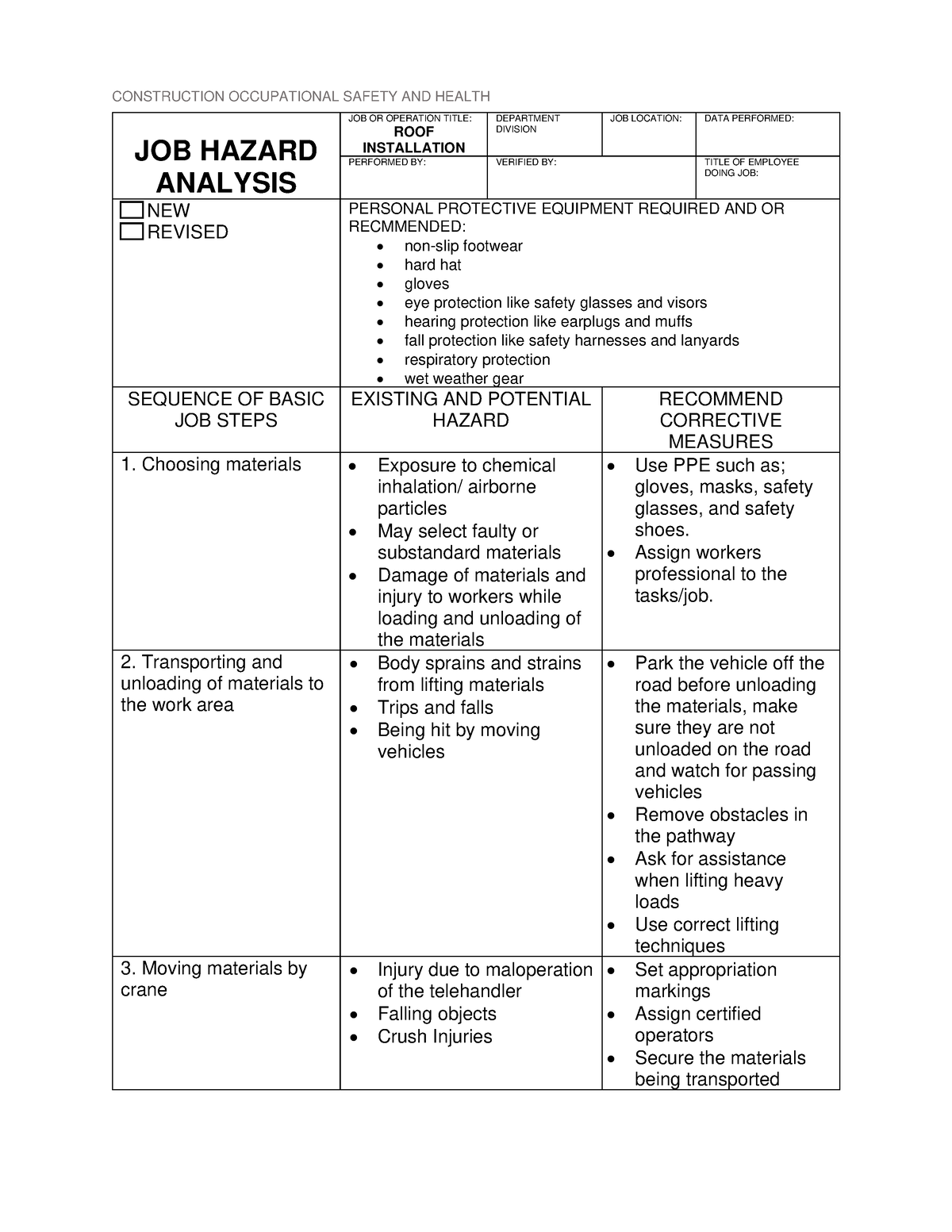

In the realm of workplace safety, secure the good being of employees is paramount. One of the most efficient methods to reach this is through an Activity Hazard Analysis (AHA). This process involves a taxonomical approach to identifying potential hazards associated with specific activities and enforce measures to mitigate these risks. By conducting an AHA, organizations can create a safer work environment, cut the likelihood of accidents, and enhance overall productivity.
Understanding Activity Hazard Analysis
An Activity Hazard Analysis is a proactive method used to evaluate the risks regard in various workplace activities. It goes beyond mere compliance with safety regulations; it aims to foster a acculturation of safety and continuous improvement. The chief end is to anticipate likely hazards and evolve strategies to eradicate or control them before they have harm.
An AHA typically involves respective key steps:
- Identifying the action to be analyzed.
- Breaking down the activity into individual steps.
- Identifying likely hazards at each step.
- Evaluating the risks associate with these hazards.
- Implementing control measures to mitigate the risks.
- Documenting the findings and control measures.
- Reviewing and updating the analysis sporadically.
Steps Involved in Conducting an Activity Hazard Analysis
Conducting an Activity Hazard Analysis requires a structure approach. Here are the detailed steps imply:
Step 1: Identify the Activity
The first step is to clearly delimitate the activity that will be canvass. This could be any task or summons within the workplace, such as operating machinery, handle risky materials, or perform care tasks. The action should be specific and well defined to secure a thorough analysis.
Step 2: Break Down the Activity
Once the activity is identified, it should be interrupt down into item-by-item steps. This involves make a detailed list of all the actions expect to complete the action. Each step should be clearly report to see that no likely hazards are overlooked.
Step 3: Identify Potential Hazards
For each step in the action, potential hazards should be identified. Hazards can be physical, chemic, biological, or ergonomic in nature. Common hazards include:
- Falls from heights
- Electrical hazards
- Chemical exposures
- Mechanical hazards
- Ergonomic issues
Step 4: Evaluate the Risks
After place the hazards, the next step is to evaluate the risks assort with each hazard. This involves evaluate the likelihood of the hazard pass and the possible severity of the consequences. Risk valuation helps prioritise control measures based on the point of risk.
Step 5: Implement Control Measures
Based on the risk rating, capture control measures should be enforce to mitigate the identified hazards. Control measures can be categorized into four levels:
- Elimination: Removing the hazard entirely.
- Substitution: Replacing the hazard with a less dangerous alternative.
- Engineering controls: Using physical barriers or equipment to control the hazard.
- Administrative controls: Implementing procedures and training to minimize the risk.
- Personal protective equipment (PPE): Using PPE as a last resort when other controls are not feasible.
Step 6: Document the Findings
Documenting the findings of the Activity Hazard Analysis is all-important for insure that the analysis is comprehensive and that control measures are effectively implemented. The documentation should include:
- A description of the action.
- A list of individual steps.
- Identified hazards for each step.
- Risk evaluations.
- Implemented control measures.
Step 7: Review and Update
An Activity Hazard Analysis is not a one time task; it should be reviewed and updated sporadically to ascertain its relevancy and strength. Changes in the workplace, new equipment, or updated procedures may ask revisions to the analysis. Regular reviews help sustain a safe act environment and adapt to develop risks.
Note: It is essential to involve employees in the AHA process. Their insights and experiences can provide worthful info about potential hazards and effective control measures.
Benefits of Conducting an Activity Hazard Analysis
Conducting an Activity Hazard Analysis offers legion benefits to organizations:
- Improved Safety: By name and mitigating hazards, AHAs aid make a safer work environment, trim the risk of accidents and injuries.
- Compliance: AHAs ensure that organizations comply with safety regulations and standards, obviate possible effectual issues.
- Cost Savings: Preventing accidents and injuries can take to important cost savings by trim medical expenses, workers' recompense claims, and downtime.
- Enhanced Productivity: A safe work environment fosters employee morale and productivity, as workers feel respect and protected.
- Continuous Improvement: Regularly critique and updating AHAs promotes a culture of continuous improvement, where safety is an ongoing antecedency.
Common Challenges in Conducting an Activity Hazard Analysis
While the benefits of an Activity Hazard Analysis are clear, there are also challenges that organizations may face:
- Time and Resource Constraints: Conducting a thorough AHA can be time consuming and may ask significant resources, include personnel and equipment.
- Employee Engagement: Ensuring that employees are actively involved in the AHA process can be challenging, especially if they are resistant to vary or lack cognizance of safety issues.
- Complex Activities: Some activities may be complex and involve multiple steps and hazards, making the analysis more difficult.
- Changing Work Environments: Workplaces are dynamical, and changes in processes, equipment, or personnel can regard the relevance of the AHA.
To overcome these challenges, organizations should:
- Allocate sufficient time and resources for the AHA process.
- Provide train and education to employees on the importance of safety and their role in the AHA summons.
- Use technology and tools to streamline the analysis and documentation summons.
- Regularly review and update the AHA to reflect changes in the workplace.
Case Study: Implementing an Activity Hazard Analysis in a Manufacturing Plant
To instance the pragmatic coating of an Activity Hazard Analysis, study a manufacturing plant that produces automotive parts. The plant identified a critical activity: operating a CNC (Computer Numerical Control) machine. The AHA operation affect the following steps:
Identifying the Activity
The action was distinctly defined as "function a CNC machine to create self-propelled parts".
Breaking Down the Activity
The activity was broken down into the following steps:
- Preparing the machine for operation.
- Loading the raw material.
- Programming the machine.
- Running the machine.
- Unloading the end parts.
- Maintaining the machine.
Identifying Potential Hazards
Potential hazards were identified for each step:
| Step | Potential Hazards |
|---|---|
| Preparing the machine | Electrical hazards, mechanical hazards |
| Loading the raw material | Ergonomic issues, mechanical hazards |
| Programming the machine | Ergonomic issues, software errors |
| Running the machine | Mechanical hazards, noise exposure |
| Unloading the finished parts | Ergonomic issues, mechanical hazards |
| Maintaining the machine | Electrical hazards, mechanical hazards |
Evaluating the Risks
The risks link with each hazard were evaluated based on likelihood and rigor. for instance, the risk of electric hazards during machine preparation was deal high due to the potential for severe injuries.
Implementing Control Measures
Control measures were apply to palliate the identified risks:
- Electrical hazards: Ensuring proper anchor and using lockout tagout procedures.
- Mechanical hazards: Installing guards and safety interlocks.
- Ergonomic issues: Providing ergonomic educate and adjust workstations.
- Noise exposure: Using learn protection and implement noise diminution measures.
Documenting the Findings
The findings were documented in a detailed report, including the identify hazards, risk evaluations, and implemented control measures. The report was shared with all relevant personnel and posted in the workplace for easy reference.
Reviewing and Updating
The AHA was reviewed annually and updated as postulate to reflect changes in the workplace, such as new equipment or update procedures. Regular reviews ensured that the analysis stay relevant and effective.
Note: Involving employees in the AHA procedure can supply worthful insights and secure that control measures are practical and efficient.
By bear an Activity Hazard Analysis, the construct plant was able to create a safer work environment, trim the risk of accidents, and raise overall productivity. The AHA process helped identify potential hazards and implement efficacious control measures, ascertain the good being of employees and the success of the arrangement.
to sum, an Activity Hazard Analysis is a important tool for ensuring workplace safety. By systematically identifying and extenuate potential hazards, organizations can create a safer work environment, trim the risk of accidents, and enhance overall productivity. The benefits of conducting an AHA are numerous, including amend safety, compliance with regulations, cost savings, enhanced productivity, and a acculturation of continuous improvement. While there are challenges to direct an AHA, such as time and resource constraints, employee engagement, and complex activities, these can be overcome with proper plan and execution. By regard employees in the summons and regularly reexamine and updating the analysis, organizations can control that their AHA remains relevant and effective. The case study of the manufacturing plant illustrates the virtual coating of an AHA and its confident impingement on workplace safety and productivity. Through a structure and proactive approach, organizations can foster a culture of safety and continuous improvement, benefiting both employees and the governance as a whole.
Related Terms:
- action hazard analysis sample
- activity hazard analysis pdf
- action hazard analysis aha
- action hazard analysis form
- usace activity hazard analysis
- action hazard awareness